

Continuous Flow Hot Water
Hot water heated as you use it, so it never runs out, sized in litres per minute for your home.
$0 CALLOUT FEE IN BUSINESS HOURS | FREE QUOTES | SAME DAY SERVICE



NOW SERVICING NORTH SYDNEY
WE ARE AVAILABLE
- 35+ Years of Combined Experience
- Yes, a Real Plumber Reads These Messages Too
- The Kettle Is Always On at Head Office
- $0 Call Out Fees
- Every Job Photographed, Every Price Upfront
- We Answer the Phone. Revolutionary, We Know.
- Trusted by 15,000+ Sydney Families
- No Call Centres. You Get a Human in Sydney
- Your Neighbours Probably Have Our Fridge Magnet
- Onsite in 30 Minutes Guaranteed
- Boots Off at the Door. Every Single Time.
- 3,000+ Google Reviews and Counting
- In the community For the community
THE SHORT ANSWER
In short
A continuous flow system heats water only when you turn on a hot tap, so it never runs out and there is no tank to keep hot. It is sized in litres per minute: about 16 L/min suits a home with one or two bathrooms, and 26 L/min two to three bathrooms. It uses less energy than a gas storage system, but it needs a strong gas supply and is usually fitted outside. A like-for-like replacement costs about $1,700 to $3,300 installed in Sydney.
HOW IT WORKS
Heated the moment you need it
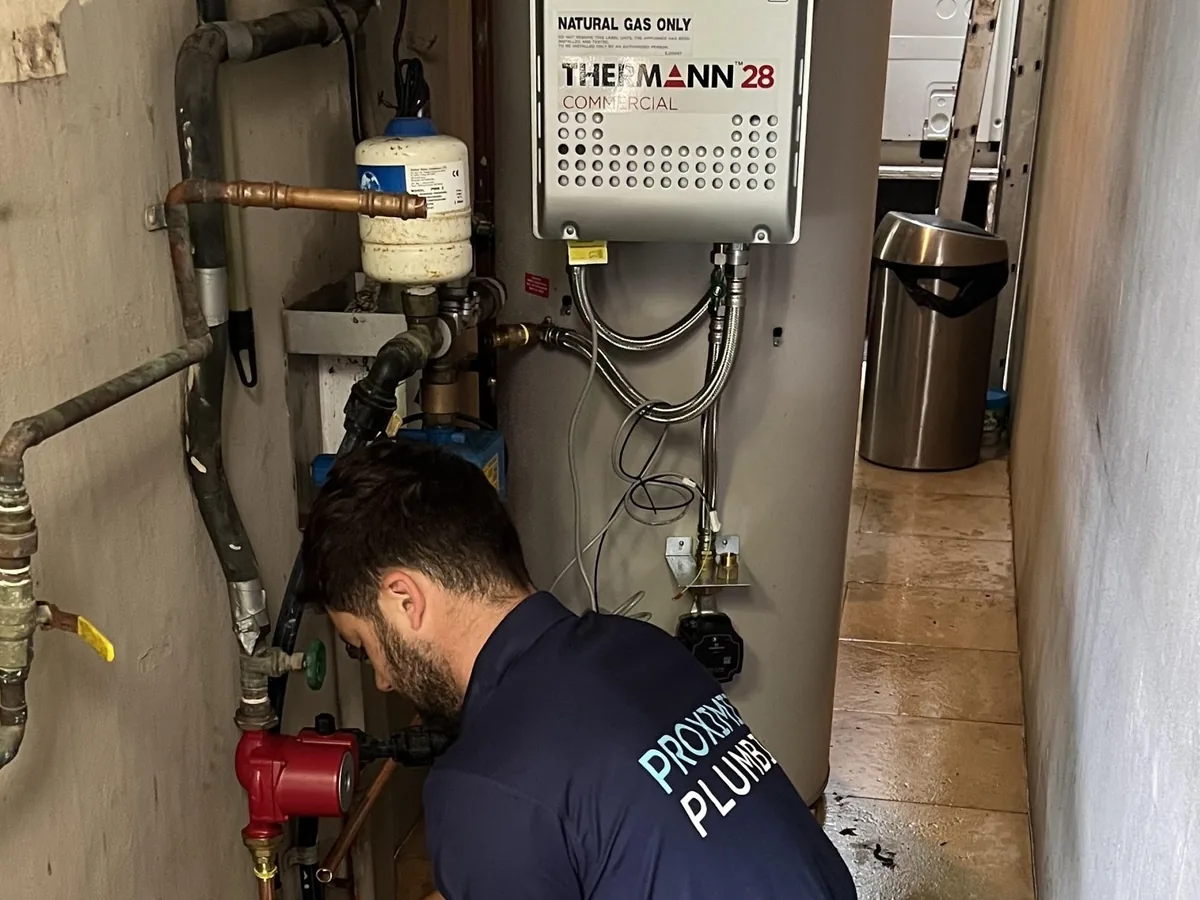
When you turn on a hot tap, water flows through the unit, a burner lights and a heat exchanger warms the water as it passes. Turn the tap off and the burner stops. There is no tank losing heat all day.
Because it burns a lot of gas at once, it needs a gas pipe and meter big enough for its flow rate; a larger unit can mean a bigger gas pipe (YourHome). Most are fitted on an outside wall because of the flue.
It is set to deliver no more than 50°C, so it meets the bathroom temperature rule without a separate tempering valve on most models.
SIZES
Litres per minute: what size you need
Continuous flow units are sized by how many litres of hot water they deliver each minute. Reece lists models of about 12, 16, 20, 26 and 28 L/min, and commercial units of 32 to 50 L/min.
| Size | Suits |
|---|---|
| 12 L/min | One bathroom, up to 2 people |
| 16 L/min | One and a half bathrooms, up to 3 people |
| 20 L/min | Up to 4 people |
| 26 L/min | Two to two and a half bathrooms, up to 5 people |
| 27 to 28 L/min | Three bathrooms or 6 people |
Facts checked 1 November 2026. Sources: YourHome, energy.gov.au, Building Commission NSW and Rheem’s sizing guide.
GAS SUPPLY
Why your gas supply decides the size you can have
A continuous flow unit burns a lot of gas at once, but only while a hot tap is open. YourHome notes that standard units give adequate hot water to only one or two places at a time, while high-performance units can supply three or more, and that the larger flows can need a bigger gas pipe or meter (YourHome).
So sizing is not only about bathrooms. The gas meter, the size and length of the gas pipe, and what else runs on gas, such as a cooktop or a heater, all decide which flow rate will work. If a bigger pipe is needed, it is far better to know before you buy the unit than after.
On LPG, instantaneous units generally need a large supply pipe as well, and a household usually needs two or more 45 kg bottles so it is not running out of gas.
TEMPERATURE
The 50°C setting and the controller
NSW accepts a water heater that is temperature-limited and marked with a 50°C maximum under AS 3498 as the temperature control device for bathrooms, in place of a separate tempering valve (Building Commission NSW). Many continuous flow units are made this way, which is why they often need no tempering valve. Others are not, so the model decides.
The 60°C rule is about water held in a tank. A continuous flow unit stores almost none, and YourHome says instantaneous systems should be set to no more than 50°C, because any hotter just wastes energy.
Controllers in the bathroom or kitchen let you set the temperature you want at the tap, so you are not mixing very hot water with cold. Some include a bath fill or a volume alarm that tells you when a set amount of hot water has run.
THE HONEST VIEW
Good to know before you choose
| What to know | |
|---|---|
| Never runs out | Hot water for as long as the gas flows: no waiting for a tank to reheat. |
| Running cost | Uses less energy than a gas storage system, because no tank is kept hot all day. |
| Gas supply | Needs a strong gas supply; larger units can need a bigger gas pipe or meter. |
| Low flows | Some models cut out at very low flows, such as a trickling basin tap. |
| Outside | Usually fitted on an outside wall, with flue clearances from windows and doors. |
| LPG | Works on bottled gas, but LPG costs about 2 to 3 times as much to run as mains gas. |
WHO IT SUITS
Is it right for your home?
Busy homes
Back-to-back showers without running out.
Small spaces
A compact unit on the wall instead of a tank.
Gas homes
Homes with mains gas and room for a bigger gas pipe if needed.
WHAT IT COSTS
Prices in Sydney
Typical Sydney prices, supplied and installed by a licensed plumber. You get a fixed price before any work starts.
| System | Installed price | Notes |
|---|---|---|
| Continuous flow, like-for-like | $1,700 to $3,300 | 16 to 26 L/min, replacing a continuous flow unit |
| Converting from a storage tank | $2,500 to $4,500 | Allow for gas pipe, flue and water pipe changes |
Typical Sydney market ranges for supply and installation, including GST (1 November 2026). Removal of the old unit is usually included; a tempering valve is about $170 to $460 where needed. Call-out: $0 Monday to Friday, 7:00am to 3:00pm, and Saturday, 7:00am to 12:00pm. Outside those times, and all day on NSW public holidays, the call-out fee is $385 ($350 plus GST), paid before we send a plumber.
BRANDS WE INSTALL
Brands we supply and install
We supply and install every continuous flow brand Reece sells, including Rinnai, Rheem and Bosch, from 12 L/min for a unit to 50 L/min for commercial jobs.
Rinnai, for example, quotes a 12-year heat exchanger warranty with 3 years parts and labour on its Infinity range. We tell you the warranty on the exact model before you choose.
LOW FLOWS
Low flows, water-saving showerheads and solar pre-heating
Some gas instantaneous units behave erratically at low flows, especially when the incoming water is already warm, such as on a hot day or when it has been pre-heated by solar. The burner cannot turn down far enough, so it shuts off for safety, and you get a burst of cold (YourHome).
If you are fitting a water-efficient showerhead, check with the maker that it suits your unit. At a basin, opening the hot tap further usually keeps the burner lit. If the cut-outs started suddenly, the cause is more likely a fault, a partly blocked inlet filter or a gas supply problem.
ELECTRIC INSTANT
Electric continuous flow: when it makes sense
Electric instantaneous units avoid tank heat losses, and YourHome puts them at about 20 to 30% more efficient than electric storage. They can still cost more to run, because they cannot be timed to off-peak or solar power, and their large draw at once can add to a peak demand charge (YourHome).
They draw up to 28 kW, which needs a three-phase supply. Single-phase models have very limited flow and suit a basin, not a shower. They are most often used in apartments, or for a single basin far from the main system. Stiebel Eltron and Bosch both make three-phase electric instant units; see hot water brands compared.
WARNING SIGNS
Signs your continuous flow unit has a fault
| What you notice | What it often means | How urgent |
|---|---|---|
| An error code on the controller | The unit has logged a fault, such as ignition, flame, overheating or a sensor | Soon. Write down the code and the model |
| Hot, then cold, then hot in the shower | A flow near the unit’s minimum, a partly blocked inlet filter or showerhead, or a failing part | Soon. Try the tap fully open first |
| No hot water, but the cooktop works | An ignition or power fault; most units need a power point to run | Today. Check the power point and the controller |
| Water dripping from the bottom of the unit | A leaking heat exchanger or fitting | Soon. Turn off the cold water to the unit if it is steady |
| Soot or a smell around the flue | Poor combustion | Stop. Turn off the gas at the meter and call a licensed gasfitter |
| Hot water takes longer to arrive | Scale in the heat exchanger, or a longer pipe run than the unit was sized for | Plan. A service can help |
ON THE DAY
Swapping a tank for continuous flow: what changes
- We find a spot on an outside wall that meets the flue clearances from windows, doors and boundaries, close to the existing pipes where we can
- We check the gas meter and pipe against the unit’s gas demand, and upsize the pipe if needed
- We run the hot and cold water to the new position and remove the old tank
- A weatherproof power point is fitted if there is not one, by a licensed electrician where required
- We commission it: gas pressure, flame, flow and temperature, and check the bathroom water is no hotter than 50°C
- You get the gas and plumbing compliance certificates and the warranty details, and we show you the controller
THE RULES IN NSW
Temperature rules every installation must meet
Storage hot water must be heated to at least 60°C at least once every 7 days, to stop bacteria such as Legionella growing (YourHome).
Water at showers, baths, basins and bidets must be no hotter than 50°C. In NSW a tempering valve or another approved device is required on every new installation and every replacement, including a like-for-like swap (Building Commission NSW). That is why a proper replacement quote includes one, and why faulty tempering valves are among the most common hot water faults in our job records.
FROM OUR JOB RECORDS
What we see on Sydney hot water jobs
Since 2019 our licensed plumbers have completed 1,125 hot water jobs. The most common causes we recorded:
- Water leak: 60 jobs
- Faulty tempering valve: 54 jobs
- Burst water pipe: 40 jobs
- Faulty hot water element or thermostat: 22 jobs
- Faulty pressure relief valve: 11 jobs
Half of our priced hot water jobs cost between $495 and $4,015, with a median of $1,980: repairs and replacements together, every type.
QUESTIONS
Questions about continuous flow hot water
MORE TYPES
Other hot water systems
READ MORE
Hot water guides

SYDNEY’S 24/7 PLUMBER
Talk to us about your hot water
A licensed plumber will size the right system for your home and give you a fixed price before any work starts.
Licensed NSW 285594C
$0 call-out in business hours
Lifetime labour warranty
4.9 from 3,000+ reviews