

Gas Hot Water Systems
A tank of hot water heated by a gas burner, sized for your household, replaced like-for-like.
$0 CALLOUT FEE IN BUSINESS HOURS | FREE QUOTES | SAME DAY SERVICE



NOW SERVICING NORTH SYDNEY
WE ARE AVAILABLE
- 35+ Years of Combined Experience
- Yes, a Real Plumber Reads These Messages Too
- The Kettle Is Always On at Head Office
- $0 Call Out Fees
- Every Job Photographed, Every Price Upfront
- We Answer the Phone. Revolutionary, We Know.
- Trusted by 15,000+ Sydney Families
- No Call Centres. You Get a Human in Sydney
- Your Neighbours Probably Have Our Fridge Magnet
- Onsite in 30 Minutes Guaranteed
- Boots Off at the Door. Every Single Time.
- 3,000+ Google Reviews and Counting
- In the community For the community
THE SHORT ANSWER
In short
A gas storage system keeps a tank of water hot with a gas burner, so it delivers plenty of hot water at once. Sizes run from about 90 L to 170 L. It is among the more expensive systems to run, because the tank loses heat all day; continuous flow gas uses less energy, and heat pumps and solar less again. A like-for-like 135 to 170 L replacement costs about $2,100 to $3,300 installed in Sydney.
HOW IT WORKS
A gas burner under an insulated tank
A gas burner under the tank heats the water, and a thermostat keeps it at 60°C or more. Hot water is drawn from the top of the tank as you use it, and the burner relights to reheat it.
Gas tanks come as outdoor models and as indoor models that need a flue. A like-for-like replacement is usually the quickest and simplest job, because the gas, water and flue are already in place.
A tempering valve keeps bathroom water at 50°C or less, as NSW requires on every replacement (Building Commission NSW).
SIZES
Tank sizes by household
Gas tanks recover heat faster than electric tanks, so a smaller gas tank can serve the same household. Reece lists gas storage tanks of 90, 130, 135, 155, 160 and 170 L.
| Tank size | Suits |
|---|---|
| 90 L | 1 to 2 people |
| 130 to 135 L | A small family |
| 155 to 170 L | A family home |
Facts checked 1 November 2026. Sources: YourHome, energy.gov.au, Building Commission NSW and Rheem’s sizing guide.
RUNNING COSTS
Why a gas tank costs more to run than you might expect
A gas storage tank pays for its hot water twice: once to heat it, and again to keep it hot while nobody is using it. For fire safety there is no insulation under the tank where the burner sits, and the insulation around the outside can be minimal, so gas tanks usually lose more heat than electric tanks (YourHome). Older models with a standing pilot light also burn a small flame day and night.
Your real cost depends on three things: the gas tariff on your bill, how much hot water your household uses, and how much heat the tank and its pipes lose. Nobody can give you an honest dollar figure without those, so be wary of a running cost quoted without a look at your bills.
The cheapest saving is using less hot water. Showers use most of it, and YourHome says a 4-star WELS showerhead can cut shower hot water use by about half. Keeping the pipe from the tank to the house short, and insulated where it runs outside, also helps.
On bottled LPG, the same tank costs about two to three times as much to run as on mains gas, and you will usually need two or more 45 kg bottles so you are not changing them constantly.
WARNING SIGNS
Signs your gas storage system needs attention
| What you notice | What it often means | How urgent |
|---|---|---|
| A smell of gas near the unit | A leak at a fitting, the gas control or the pipe | Emergency. Turn off the gas at the meter, open doors and windows, use no switches or flames, leave, and call Jemena on 131 909 from outside, or 000 if lives are at risk |
| Soot, scorch marks or a yellow, lazy flame | Poor combustion, often from a blocked flue or burner, or not enough air reaching it | Stop using it. Turn off the gas at the meter and call a licensed gasfitter |
| The pilot keeps going out | A worn thermocouple, a draught across the burner, or a gas control fault | Soon. Relighting it again and again does not fix the cause |
| Water pooling under the tank | A leaking fitting or valve, or a tank that has rusted through | Today. Turn off the cold water to the tank |
| Rumbling or popping as it heats | Sediment on the tank floor, which the burner has to heat through | Plan. Worth a check, especially on an older tank |
| Hot water runs out sooner than it used to | A thermostat or gas control fault, sediment, or a household that has grown | Soon. Book a check before it fails outright |
THE HONEST VIEW
Good to know before you choose
| What to know | |
|---|---|
| Plenty at once | A full tank of hot water, and a gas burner that reheats quickly. |
| Running cost | Among the more expensive systems to run: the tank loses heat all day. |
| Simple swap | Replacing like-for-like is quick, because the gas and flue are already there. |
| Alternatives | Continuous flow gas uses less energy; a heat pump or solar less again. |
| LPG | Bottled gas costs about 2 to 3 times as much to run as mains gas. |
| Space | Needs room for the tank, usually outside. |
WHO IT SUITS
Is it right for your home?
Quick replacement
A like-for-like swap when your old gas tank fails.
Big households at once
Several showers in a row from a full tank.
Existing gas homes
Homes with gas and a tank already in place.
WHAT IT COSTS
Prices in Sydney
Typical Sydney prices, supplied and installed by a licensed plumber. You get a fixed price before any work starts.
| System | Installed price | Notes |
|---|---|---|
| Gas storage, 135 to 170 L | $2,100 to $3,300 | Like-for-like replacement |
| Switching to continuous flow instead | $2,500 to $4,500 | See continuous flow |
Typical Sydney market ranges for supply and installation, including GST (1 November 2026). Removal of the old unit is usually included; a tempering valve is about $170 to $460 where needed. Call-out: $0 Monday to Friday, 7:00am to 3:00pm, and Saturday, 7:00am to 12:00pm. Outside those times, and all day on NSW public holidays, the call-out fee is $385 ($350 plus GST), paid before we send a plumber.
BRANDS WE INSTALL
Brands we supply and install
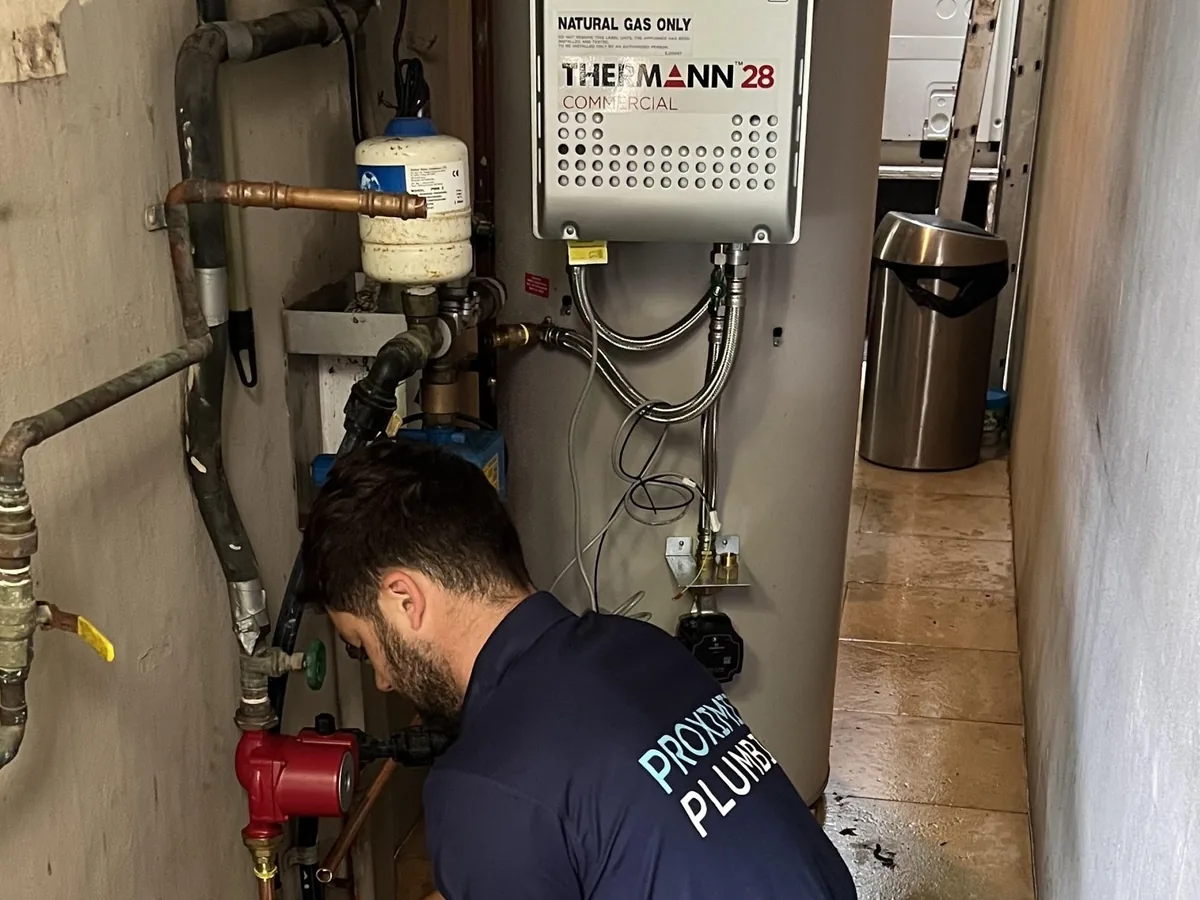
We supply and install every gas storage brand Reece sells, including Rheem, Everhot, Aquamax, Thermann and Vulcan.
Rheem, for example, gives a 10-year cylinder warranty on its 170 L gas storage tank. We tell you the warranty on the exact model before you choose.
GAS SAFETY
What you can and cannot do with a gas tank
Gas work in NSW is for licensed gasfitters only. Your part as an owner is simple: keep the area around the burner and the flue clear of boxes, garden waste and stored chemicals, never cover the air openings, and never remove the burner cover or try to adjust the gas control.
If you smell gas, turn off the gas at the meter, open doors and windows, use no switches or flames, leave, and call Jemena on 131 909 from outside, or 000 if lives are at risk. What to do about a gas leak.
Do not wrap a gas tank that has a pilot light in an insulation blanket. YourHome warns the stored water can overheat, especially in hot weather (YourHome).
After gas work on a network gas installation, the gasfitter must test it for defects and lodge a certificate of compliance with Building Commission NSW within 5 business days (NSW Government). We give you a copy of the gas certificate.
LOOKING AFTER IT
Simple care that helps a gas tank last
- Keep it breathing: a gas burner needs a steady supply of air and a clear flue. Plants, bins and lean-to shelters crowding the unit are a common reason for poor combustion
- Watch the flame and the flue: a change in flame colour, new soot, or a smell when it fires up is a reason to call, not to wait
- Have the anode checked every few years: glass-lined tanks rely on it to slow corrosion, and once it is used up the tank itself starts to rust
- Look after the relief valve: follow the maker’s guide for lifting its lever, and call if water runs from its drain steadily rather than in small amounts while heating
Your owner’s guide or the label on the tank gives the maker’s own service intervals. If you cannot find it, the model number on the data plate is enough for us to look it up.
ON THE DAY
How a gas tank replacement runs
- We turn off the gas and the cold water to the old tank and drain it, which takes a while on a full tank
- We disconnect the gas, the water and, on an indoor model, the flue, and carry the old tank out
- The new tank goes on a level base with the clearances the maker and the gas rules require; an indoor model has its flue reconnected
- A new tempering valve or another approved device goes in, as NSW requires on every replacement, like-for-like included
- We fill the tank before lighting it, test the gas work for leaks, light the burner and check the flame
- Once it is hot, we check the water at a bathroom tap is no hotter than 50°C, and leave you the gas certificate, the plumbing compliance certificate and the warranty details
THINKING OF SWITCHING?
Should you replace gas with gas?
When a gas tank fails, a like-for-like swap is the fastest way back to hot water. If you have time to choose, YourHome suggests owners of gas systems consider an efficient electric system to cut running costs and emissions (YourHome).
Energy NSW indicates a discount of up to $330 when an air source heat pump replaces a gas water heater (Energy NSW), and up to $550 when a gas-boosted solar system replaces one (Energy NSW). The amounts are indicative, depend on the model and your home, and we confirm eligibility for a gas replacement in the quote. How the discounts work.
If hot water is your only gas appliance, ask your gas retailer what happens to the supply charge once nothing in the house uses gas. A heat pump needs a power circuit and an outdoor spot with airflow, away from bedroom windows. When your tank has already failed, ask us to quote both options side by side.
THE RULES IN NSW
Temperature rules every installation must meet
Storage hot water must be heated to at least 60°C at least once every 7 days, to stop bacteria such as Legionella growing (YourHome).
Water at showers, baths, basins and bidets must be no hotter than 50°C. In NSW a tempering valve or another approved device is required on every new installation and every replacement, including a like-for-like swap (Building Commission NSW). That is why a proper replacement quote includes one, and why faulty tempering valves are among the most common hot water faults in our job records.
FROM OUR JOB RECORDS
What we see on Sydney hot water jobs
Since 2019 our licensed plumbers have completed 1,125 hot water jobs. The most common causes we recorded:
- Water leak: 60 jobs
- Faulty tempering valve: 54 jobs
- Burst water pipe: 40 jobs
- Faulty hot water element or thermostat: 22 jobs
- Faulty pressure relief valve: 11 jobs
Half of our priced hot water jobs cost between $495 and $4,015, with a median of $1,980: repairs and replacements together, every type.
QUESTIONS
Questions about gas storage hot water
MORE TYPES
Other hot water systems
READ MORE
Hot water guides

SYDNEY’S 24/7 PLUMBER
Talk to us about your hot water
A licensed plumber will size the right system for your home and give you a fixed price before any work starts.
Licensed NSW 285594C
$0 call-out in business hours
Lifetime labour warranty
4.9 from 3,000+ reviews