
“From scheduling an appointment to the actual repair, everything was seamless and efficient. Our plumber, Jack, was professional, knowledgeable and went above and beyond to ensure our issue was fixed to our satisfaction. The team provided us with a clear explanation of the problem and the solution, and we appreciated their honesty and transparency.”

Hot Water Replacement
When it is time for a new system: the signs, the choices and real Sydney prices, installed by licensed plumbers, often the same day.
$0 CALLOUT FEE IN BUSINESS HOURS | FREE QUOTES | SAME DAY SERVICE



NOW SERVICING NORTH SYDNEY
WE ARE AVAILABLE
- 35+ Years of Combined Experience
- Yes, a Real Plumber Reads These Messages Too
- The Kettle Is Always On at Head Office
- $0 Call Out Fees
- Every Job Photographed, Every Price Upfront
- We Answer the Phone. Revolutionary, We Know.
- Trusted by 15,000+ Sydney Families
- No Call Centres. You Get a Human in Sydney
- Your Neighbours Probably Have Our Fridge Magnet
- Onsite in 30 Minutes Guaranteed
- Boots Off at the Door. Every Single Time.
- 3,000+ Google Reviews and Counting
- In the community For the community
THE SHORT ANSWER
In short
Most hot water systems last about 8 to 10 years. Replace yours when the tank itself leaks, when an ageing tank gives rusty hot water or rumbles, or when repairs keep adding up. A like-for-like replacement is often done the same day. In Sydney it costs about $1,000 to $3,300 installed for electric, gas storage or continuous flow, and $3,800 to $8,000 for a heat pump or solar system before discounts. Every replacement includes a tempering valve or another approved device, as NSW requires, and you get a fixed price before any work starts.
SIGNS IT IS TIME
Signs it is time to replace your hot water system
The signs our plumbers look for, and what each one usually means.
| Sign | What it usually means | Repair or replace? |
|---|---|---|
| Water leaking from the tank itself | The inner tank has corroded through | Replace: a leaking tank cannot be repaired |
| Rusty or brown hot water | Corrosion inside the tank, often once the anode has worn away (if the cold is rusty too, it is more likely the pipes) | Replace the anode early on; once the tank is rusting, replace the system |
| Rumbling, popping or banging | Sediment building up at the bottom of the tank | Often fixed by flushing; on an old tank, a sign it is wearing out |
| Not enough hot water any more | A failed element or thermostat, or a household that has outgrown the system | Repair the part, or replace with a bigger or different system |
| Age: about 8 to 10 years or more | Most systems last about 8 to 10 years | Plan a replacement before it fails, rather than on a cold morning |
| Repairs keep adding up | Several faults in a year | Replacing often costs less than repairing again |
| High power or gas bills | An older, less efficient system | Consider a heat pump or solar system, with discounts |
BEFORE AND AFTER
See the difference
Old units out, the right new system in. Drag the handle to compare.
Leaking electric unit
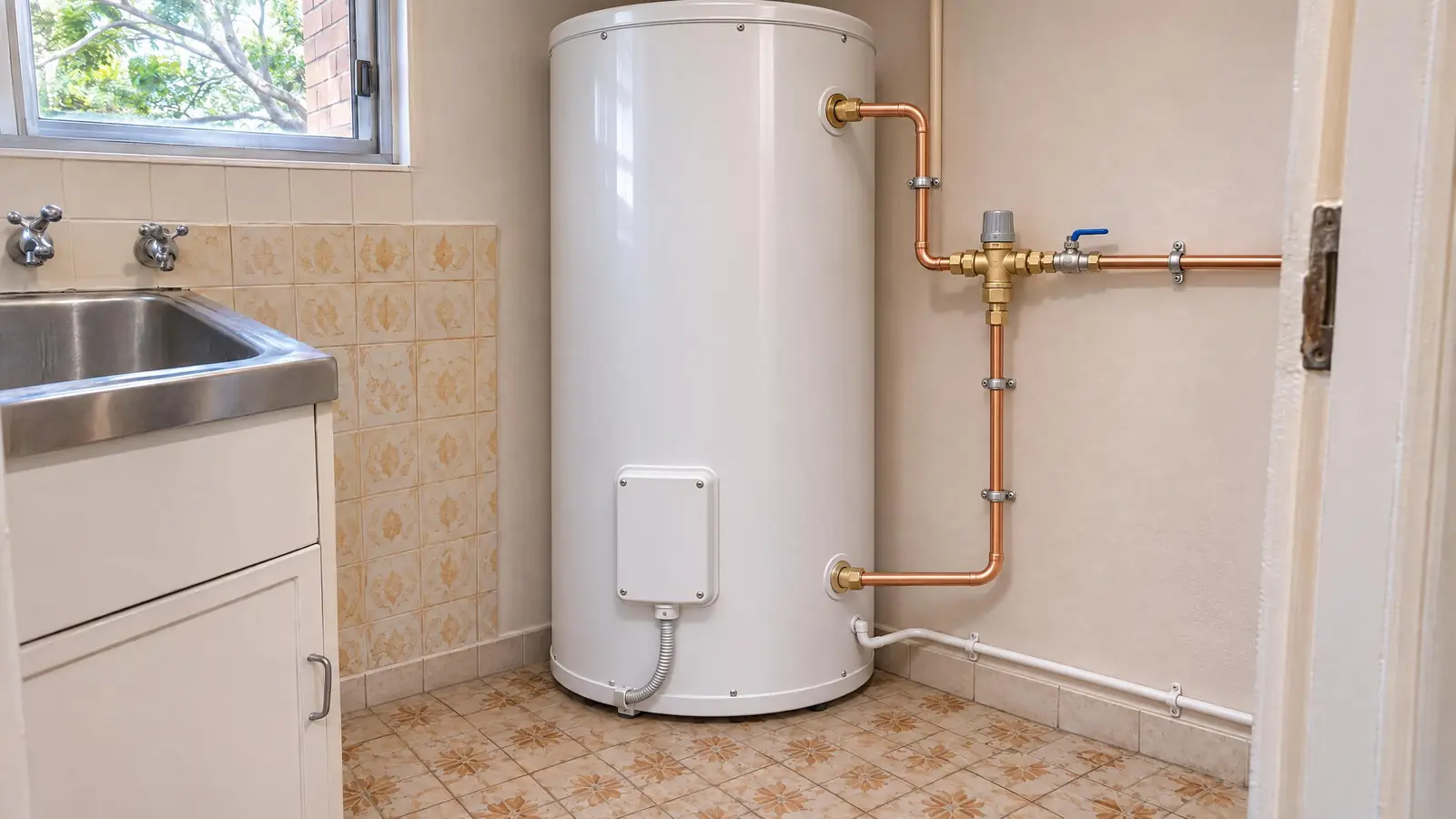
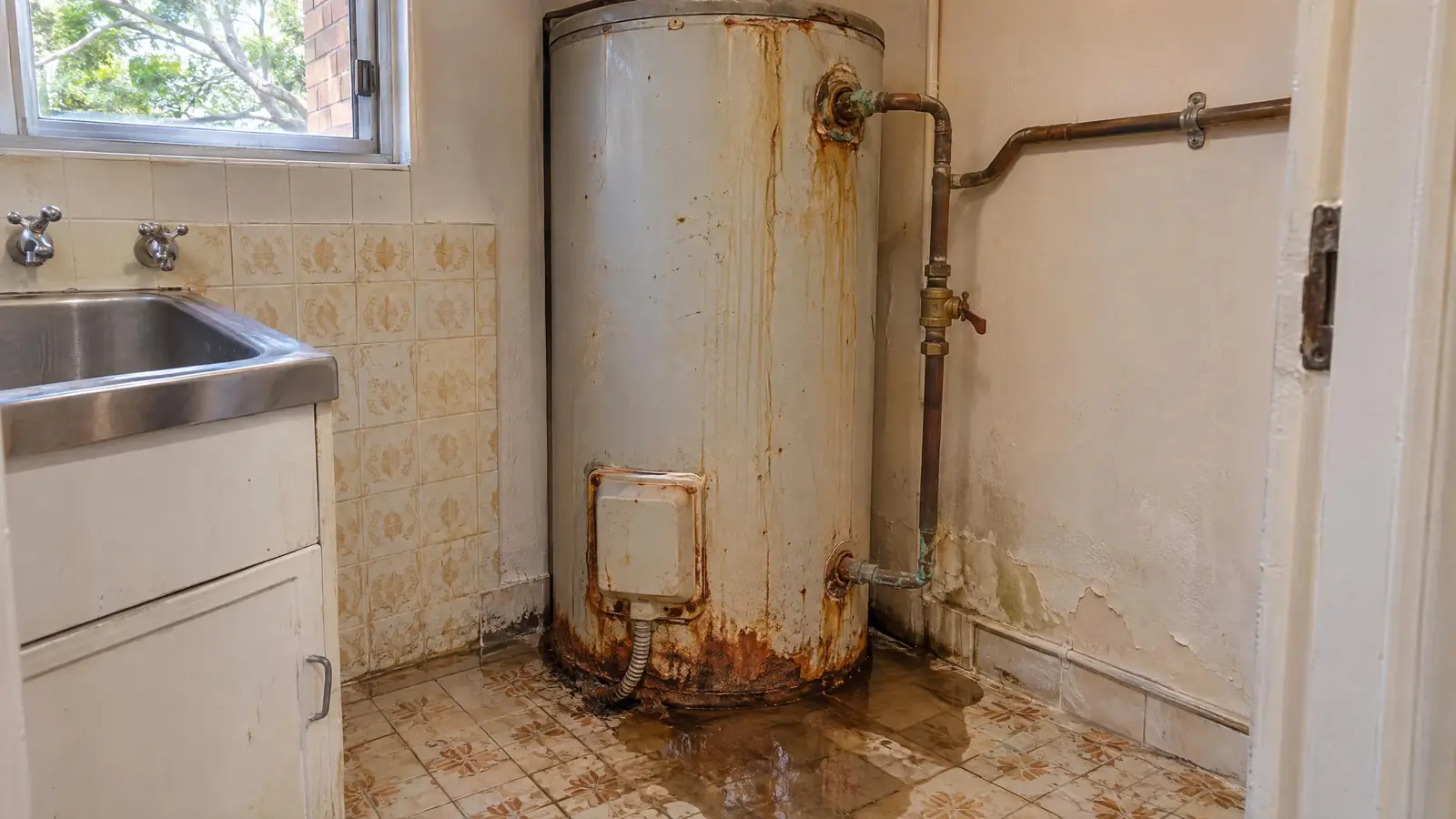
Illustration, not a Proximity job
A rusted, leaking electric storage unit, replaced with a new unit, new pipework and a tempering valve. Illustration, not a Proximity job.
Gas storage to continuous flow
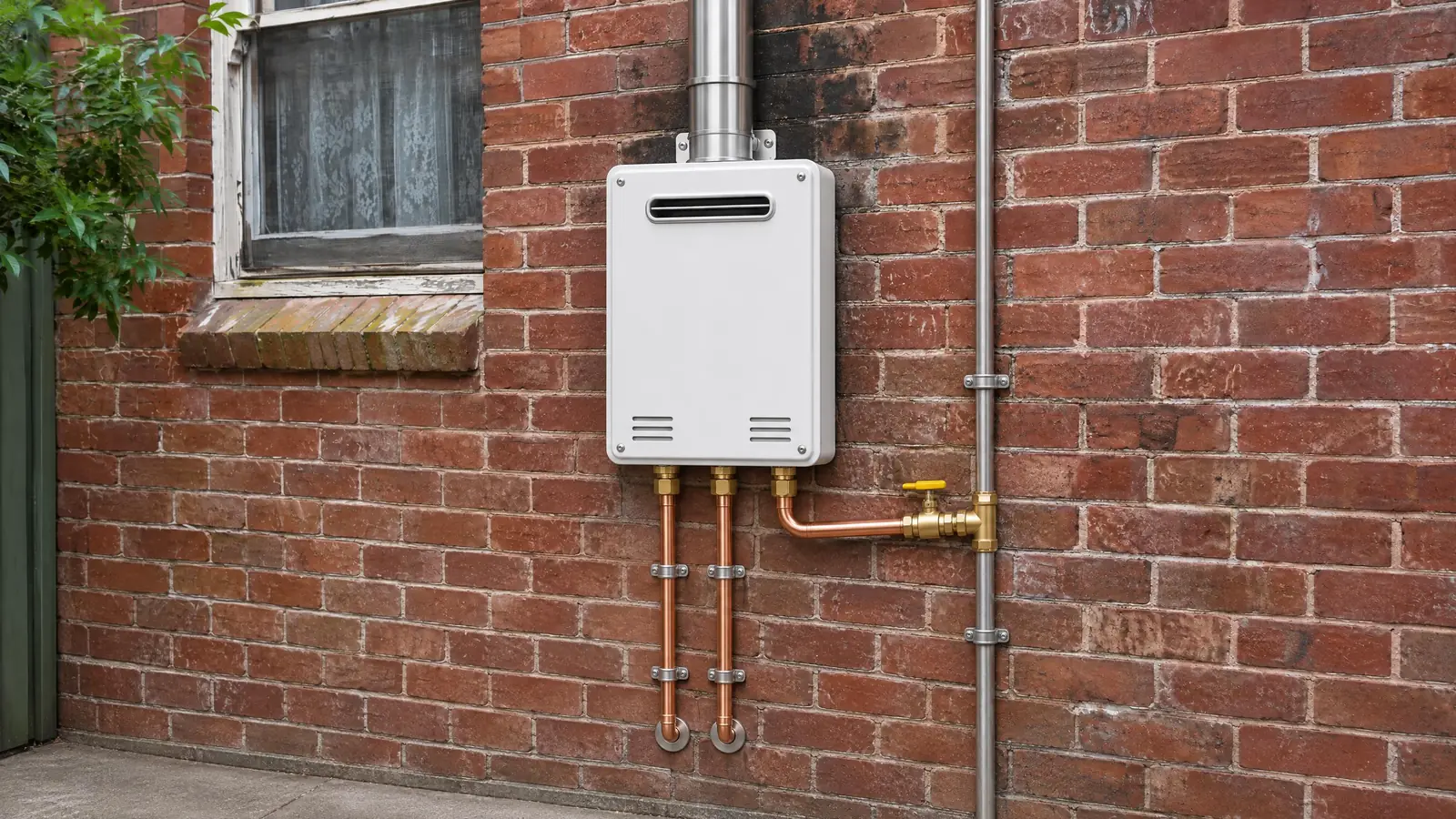
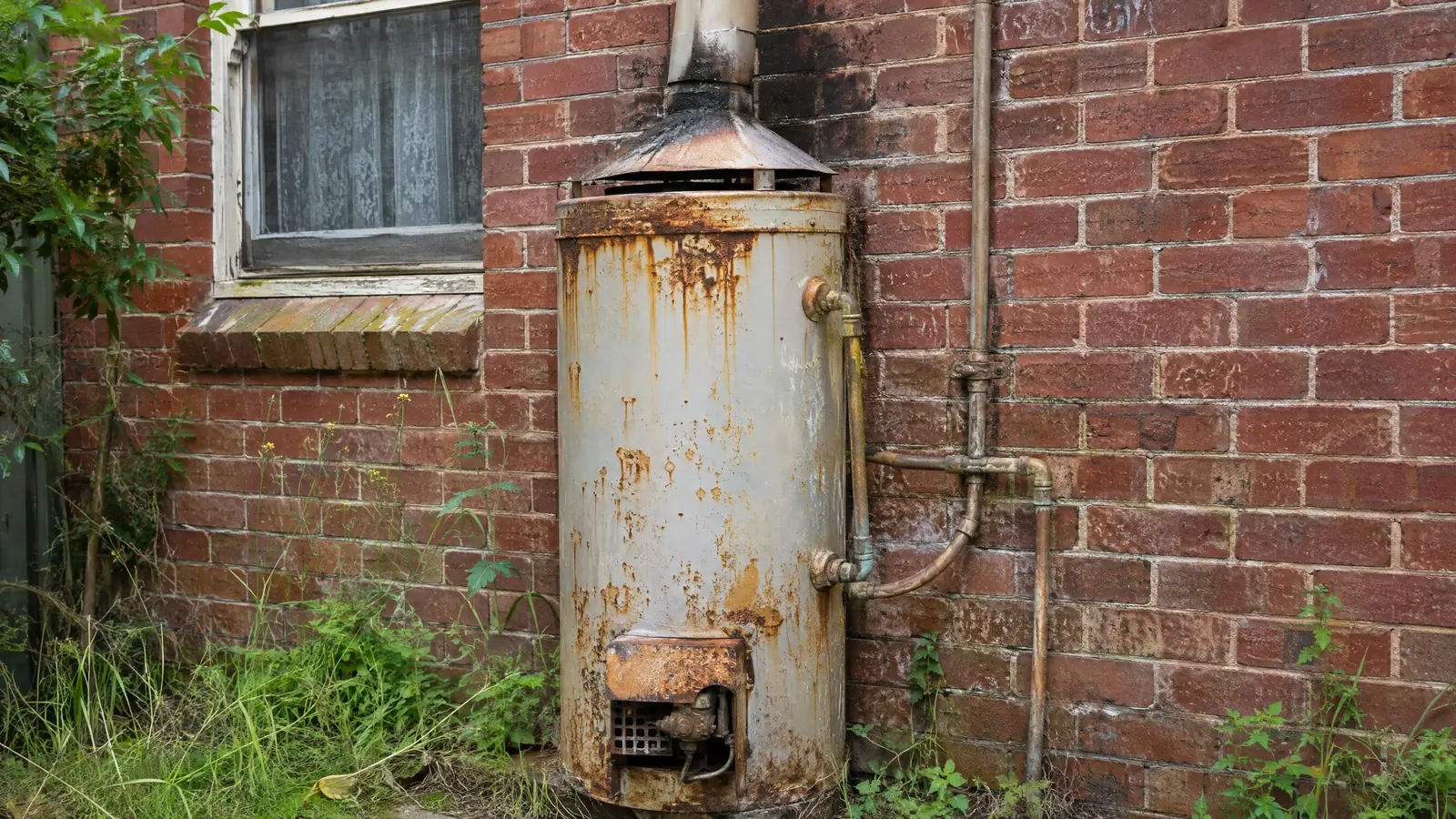
Illustration, not a Proximity job
A rusted gas storage heater, replaced with a compact continuous-flow gas unit. Illustration, not a Proximity job.
Electric to heat pump
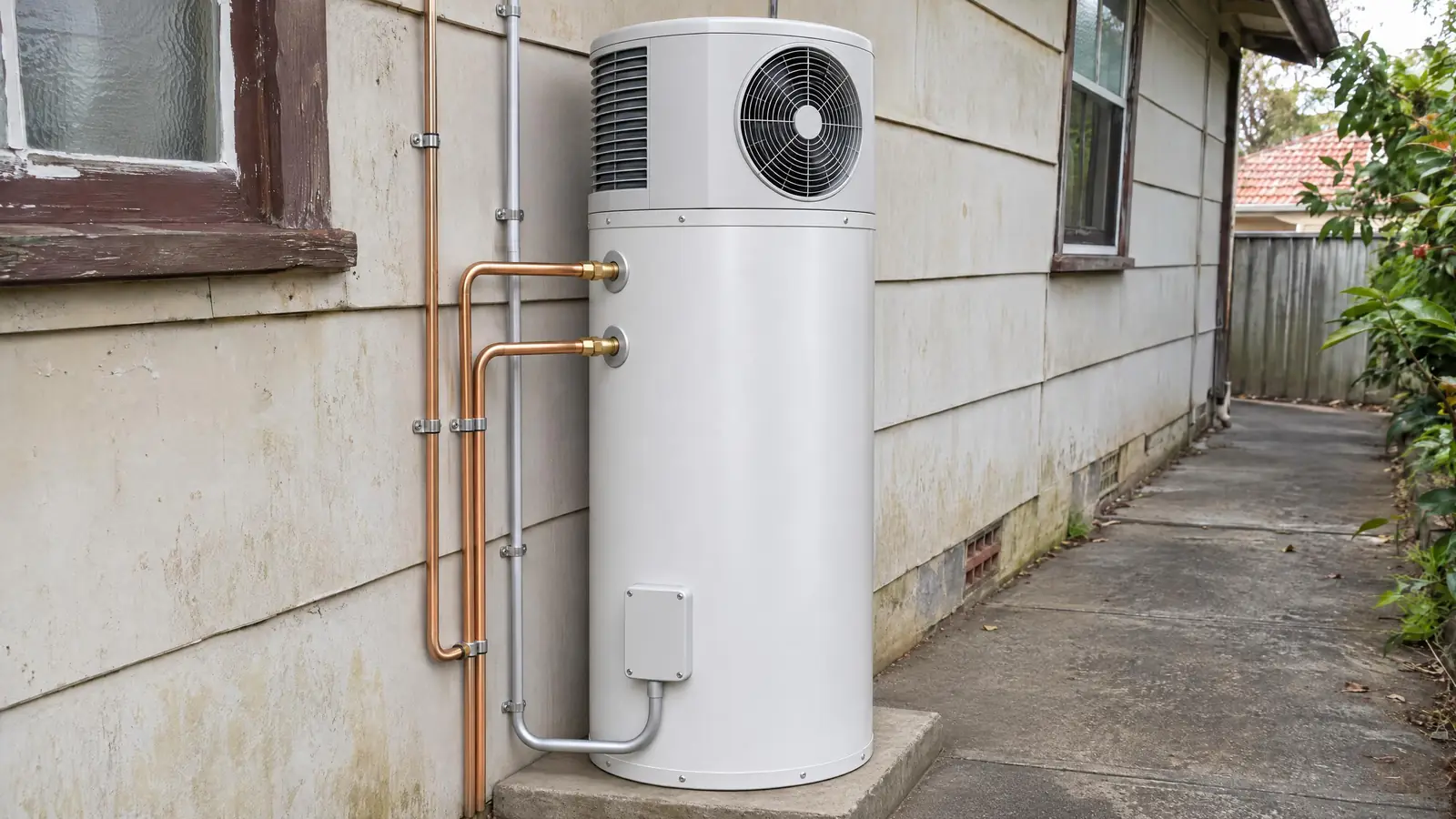
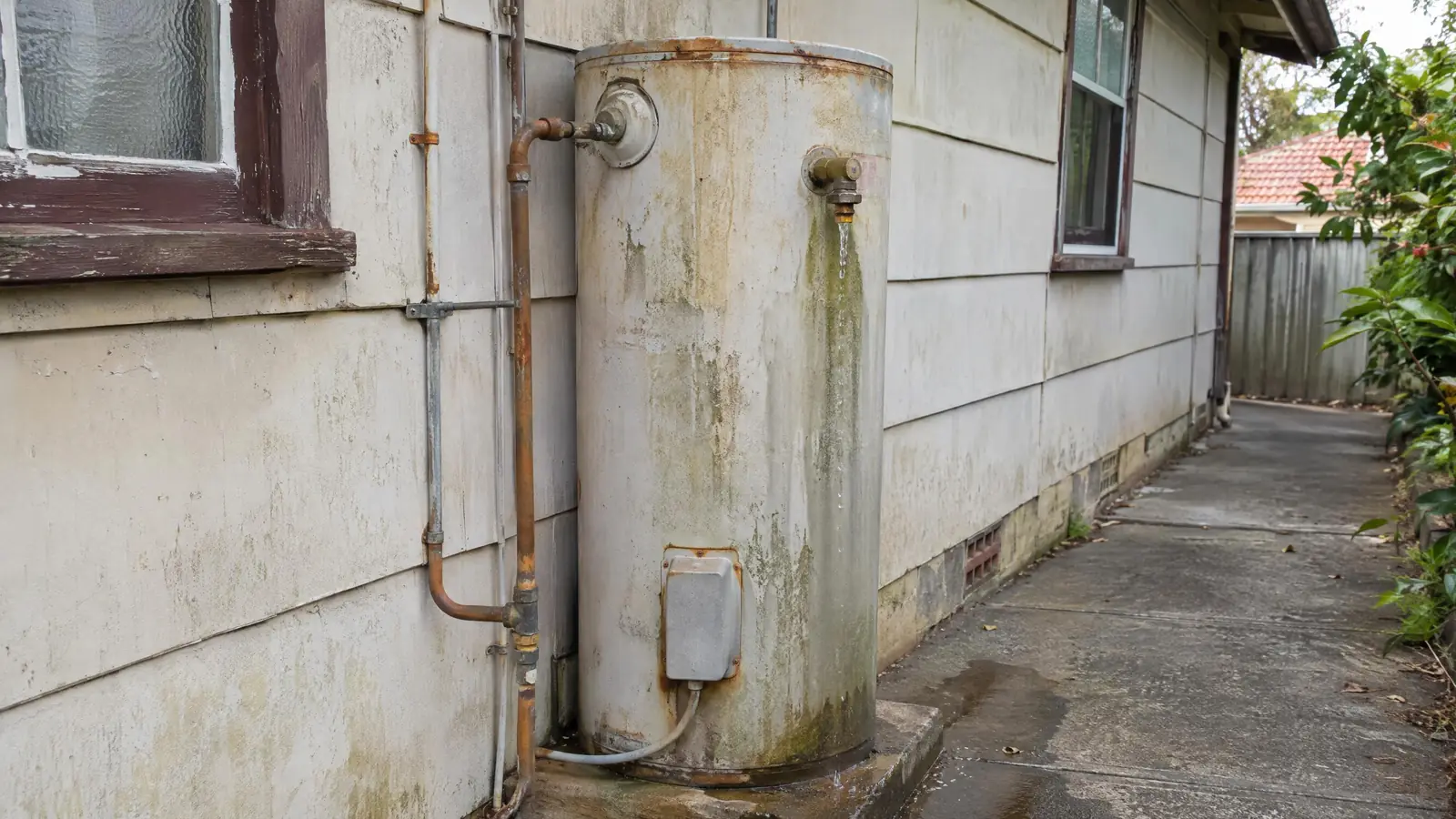
Illustration, not a Proximity job
An old electric storage tank, replaced with an energy-efficient heat pump. Illustration, not a Proximity job.
HOW LONG THEY LAST
How long does a hot water system last?
Most hot water systems last about 8 to 10 years (Solar Victoria). Some last longer, and some fail sooner: a tank that is too small works harder, and a worn-out anode leaves the tank to corrode.
What helps a system last: having the sacrificial anode checked every few years and replaced when it is worn, operating the relief valve as the maker’s manual sets out, fixing small leaks early, and flushing sediment where the maker recommends it.
BEFORE IT FAILS
Plan your replacement before the cold shower
YourHome makes a point worth repeating: you may not have much time to decide when a system fails, so if yours is ageing, look at the options now (YourHome). A replacement chosen in a hurry is usually whatever is on the shelf that morning.
Start with its age. The maker’s sticker, normally on the upper part of the unit, shows the model and usually when it was made (Solar Victoria). Photograph it, the whole system and the space around it, and send the photos with your enquiry, so we know the make, model and size before we arrive.
Then note what energy you have (mains gas, bottled gas, off-peak power, rooftop solar), how many people live there, and whether the system sits in a cupboard, on a balcony, against an outside wall or on the roof. Those answers decide which replacements will fit and which will need extra work.
CHOOSE YOUR NEW SYSTEM
Like-for-like or upgrade?
A replacement is a chance to choose the right system for the next 10 years. Prices are typical Sydney ranges, supplied and installed with GST.
| Type | Upfront cost | Running cost | Best for | Installed price |
|---|---|---|---|---|
| Electric storage | Lowest | Among the highest, lower on off-peak | Units, small homes, a low upfront price | $1,000 to $2,900 |
| Gas storage | Low | Among the higher | A quick like-for-like swap | $2,100 to $3,300 |
| Continuous flow | Low to medium | Lower than gas storage | Busy homes that never want to run out | $1,700 to $3,300 |
| Heat pump | Higher, less discounts | Among the lowest | Replacing electric; homes with solar panels | $3,800 to $6,650 |
| Solar | Highest, less STCs | Among the lowest | A sunny north-facing roof | $4,500 to $8,000 |
Like-for-like is the quickest: the same type and a similar size, with the water, power or gas and the flue already in place. When the size is in stock it is often done the same day.
Upgrading to a different type, such as electric to a heat pump or a gas tank to continuous flow, costs more on the day because of a new gas pipe, power circuit or position, but can cut your running costs for years. Heat pumps and solar systems attract discounts.
We check your household, your bathrooms, your power tariff and whether the new unit fits the old space before we recommend one: every model has its own width, depth and height.
Facts checked 1 November 2026. Sources: YourHome, energy.gov.au, Building Commission NSW and Rheem’s sizing guide.
EXPLORE
Every type of hot water system
CHANGING TYPE
Changing type: what changes on the day
| Switch | What changes | Worth knowing |
|---|---|---|
| Electric tank to heat pump | Often the same position and power supply, with room for airflow around the unit | The largest indicative NSW discount; check the model suits your off-peak tariff |
| Gas tank to continuous flow | A new spot on an outside wall, flue clearances, often a bigger gas pipe and a power point | Never runs out, and uses less gas than a tank |
| Gas to heat pump | The gas to the old tank is capped off, a power circuit is added, and the unit needs airflow away from bedrooms | Running costs usually fall; confirm the discount in the quote |
| Electric to solar | Collectors on a north-facing roof, and either a roof tank or a ground tank with a pump | The highest upfront price, and the lowest running costs on a sunny roof |
| Tank to electric instant | Only with three-phase power, and usually only for a unit or a single basin | No tank, but no off-peak or solar timing either |
WHAT IT COSTS
Hot water replacement prices in Sydney
Typical Sydney prices for a replacement, supplied and installed by a licensed plumber. You get a fixed price before any work starts.
| System | Installed price | Notes |
|---|---|---|
| Electric storage | $1,000 to $2,900 | 50 to 315 L, like-for-like |
| Gas storage | $2,100 to $3,300 | 135 to 170 L, like-for-like |
| Continuous flow | $1,700 to $3,300 | Like-for-like; $2,500 to $4,500 when converting from a storage tank |
| Heat pump | $3,800 to $6,650 | Before NSW discounts and STCs |
| Solar | $4,500 to $8,000 | Before STCs and NSW discounts |
Typical Sydney market ranges for supply and installation, including GST (1 November 2026). Removal of the old unit is usually included; a tempering valve is about $170 to $460 where needed. Call-out: $0 Monday to Friday, 7:00am to 3:00pm, and Saturday, 7:00am to 12:00pm. Outside those times, and all day on NSW public holidays, the call-out fee is $385 ($350 plus GST), paid before we send a plumber.
ON THE DAY
What happens when we replace your system
- We confirm the type, size and position with you, and give you a fixed price before any work starts
- We turn off the water and the power or gas, and drain the old system
- We fit the new system with a tempering valve or another approved device, as NSW requires on every replacement
- We fill and test it, check for leaks, and check that bathroom water is no hotter than 50°C
- We take the old system away, and leave you the warranty details for the new one
THE RULES
What the law requires when a system is replaced
- A temperature control device, every time. Building Commission NSW lists a like-for-like replacement, a change of model, size or heat source, and relocating the heater as work that needs a tempering valve or another approved device. Replacing only a valve, element or thermostat does not (Building Commission NSW)
- No Notice of Work, but a certificate. Replacing an existing hot water system is minor work that does not need a Notice of Work, but the plumber must still complete a Certificate of Compliance and give a copy to the person who arranged the work (NSW Government)
- Gas work is certified separately. After gas work on a network installation, the gasfitter must lodge a certificate of compliance with Building Commission NSW within 5 business days (NSW Government)
- Heat pumps and planning. As exempt development, a heat pump must be designed to make no more than 5 dB(A) above background noise, and on a heritage item or in a heritage conservation area it must sit in the rear yard and not on a roof (NSW Planning)
- Solar on heritage homes. Solar hot water cannot be exempt development on a lot with a heritage item unless it is not visible from any road, so ask your council before choosing it
- Licensed trades only. Plumbing by a licensed plumber, gas work by a licensed gasfitter, and wiring by a licensed electrician
For older and heritage homes, see plumbing in heritage buildings.
QUESTIONS TO ASK
Questions to ask before you approve a replacement
- Is the price fixed, and does it include the tempering valve, taking away the old system, and any gas, electrical or flue work?
- What is the warranty on the cylinder or heat exchanger, and what is the separate parts and labour term?
- Will the new system fit the space, including its height, the clearances and access for servicing?
- Does my power tariff suit the model, and can it heat on off-peak or solar power?
- Is the model eligible for the NSW discount and STCs, and are both shown on the quote?
- Which compliance certificates will I receive when the work is done?
A good answer to each is a sign of a careful installer. For more on getting a clear quote, see how to brief a plumber.
DISCOUNTS
Discounts for heat pump and solar hot water
Two schemes cut the price of an eligible heat pump or solar system. The NSW Energy Savings Scheme gives an upfront discount on the quote, which Energy NSW puts at up to $640 when a heat pump replaces an electric system and up to $330 when it replaces gas (Energy NSW), and up to $900 when a solar system replaces electric and up to $550 when it replaces gas (Energy NSW). These figures are indicative, and not every model or home qualifies.
Federal small-scale technology certificates (STCs) also apply to listed heat pumps and solar systems; their number falls each year until the scheme ends in 2030, and they are often already taken off advertised prices (Clean Energy Regulator).
Both are arranged through the installer before the work starts. We take part in the NSW Energy Savings Scheme, so we arrange the discount for you and show it on your written quote. Ask us which models qualify for your home, or read NSW hot water rebates explained.
THE RULES IN NSW
Temperature rules every installation must meet
Storage hot water must be heated to at least 60°C at least once every 7 days, to stop bacteria such as Legionella growing (YourHome).
Water at showers, baths, basins and bidets must be no hotter than 50°C. In NSW a tempering valve or another approved device is required on every new installation and every replacement, including a like-for-like swap (Building Commission NSW). That is why a proper replacement quote includes one, and why faulty tempering valves are among the most common hot water faults in our job records.
FROM OUR PROJECTS
Recent hot water replacements
REVIEWS BY PROBLEM
What your neighbours say
Real reviews from our customers across Sydney, in their own words. Read every review, good and bad, on Google.
Repairs
Hot water
Leaks
Renovations
AT A GLANCE
Key facts
Service
Hot water replacement
Part of
Types
Electric, gas storage, continuous flow, heat pump and solar
Brands
Every brand Reece sells
Call-out fee
$0 Monday to Friday, 7:00am to 3:00pm, and Saturday, 7:00am to 12:00pm. $385 outside those times and on NSW public holidays
Licence
NSW Contractor Licence 285594C
Warranty
Lifetime labour warranty
QUESTIONS
Hot water replacement questions
RELATED
More hot water
READ MORE
Hot water guides

SYDNEY’S 24/7 PLUMBER
No hot water? Call us now
A licensed plumber who fixes or replaces every brand, with a fixed price before any work starts.
Licensed NSW 285594C
$0 call-out in business hours
Lifetime labour warranty
4.9 from 3,000+ reviews